
Inflation Adjustments for Tax Year 2027
The annual average inflation rate for 2025 was 2.7% according to CPI figures. The inflation rate reported for September 2026 was 3.7%, a full percentage higher than 2026. As a result, the IRS has announced inflation adjustments for tax year 2027 covering almost 70 tax provisions. The new amounts generally apply to income earned in 2027 and to tax returns filed in 2028. In its announcement, the IRS also notes that taxpayers continue to benefit from the OBBBA.
Each item below shows the 2026 amount → the 2027 amount, with the change in parentheses. Tax bracket changes are shown in tables.
For Most Taxpayers:
Standard Deduction
Most taxpayers claim the standard deduction rather than itemizing, so this is the change that reaches affects the most people.
- Married filing jointly: $32,200 → $33,200 (+$1,000)
- Single/Married filing separately: $16,100 → $16,600 (+$500)
- Head of household: $24,150 → $24,925 (+$775)
Tax Brackets
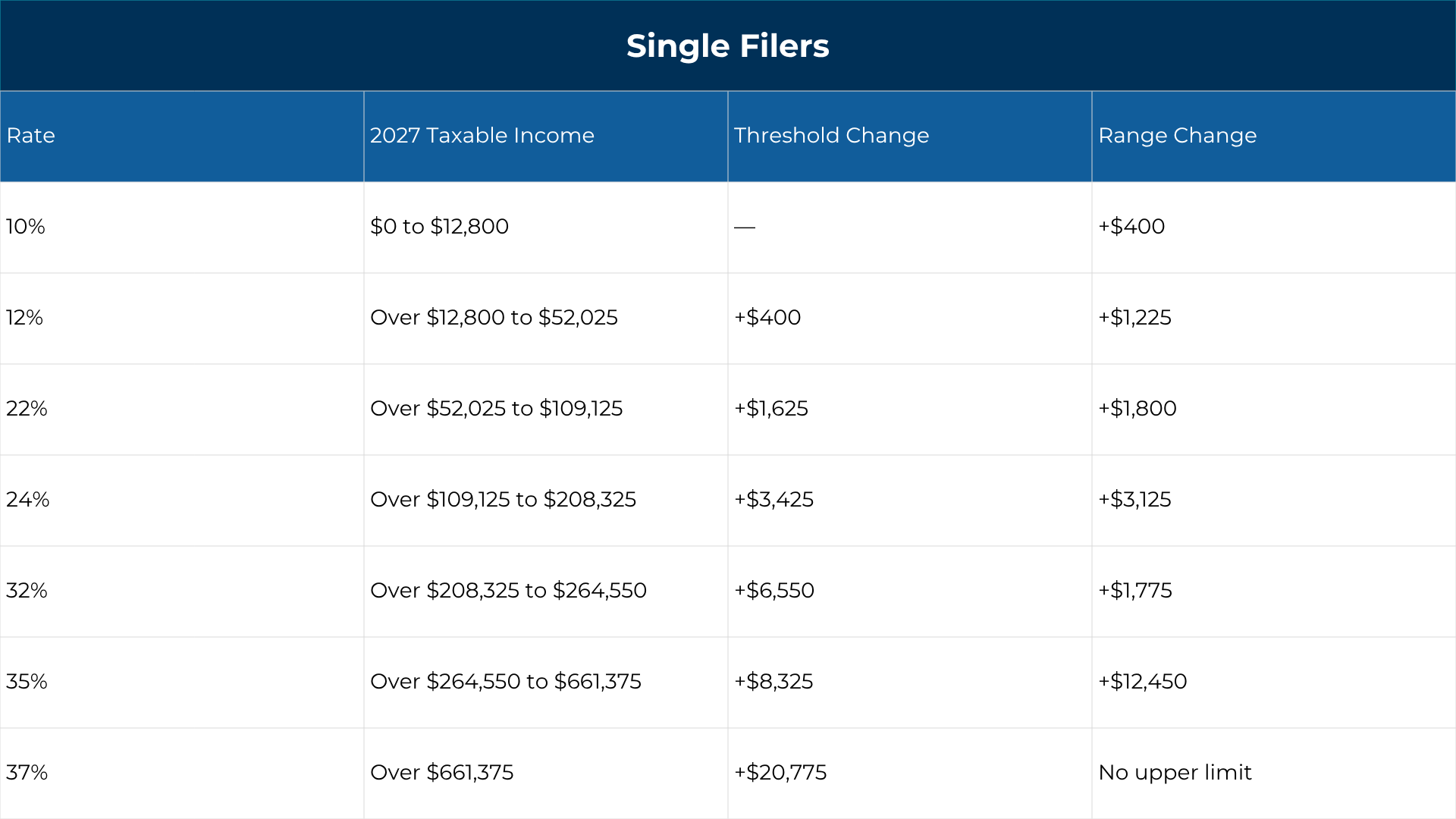
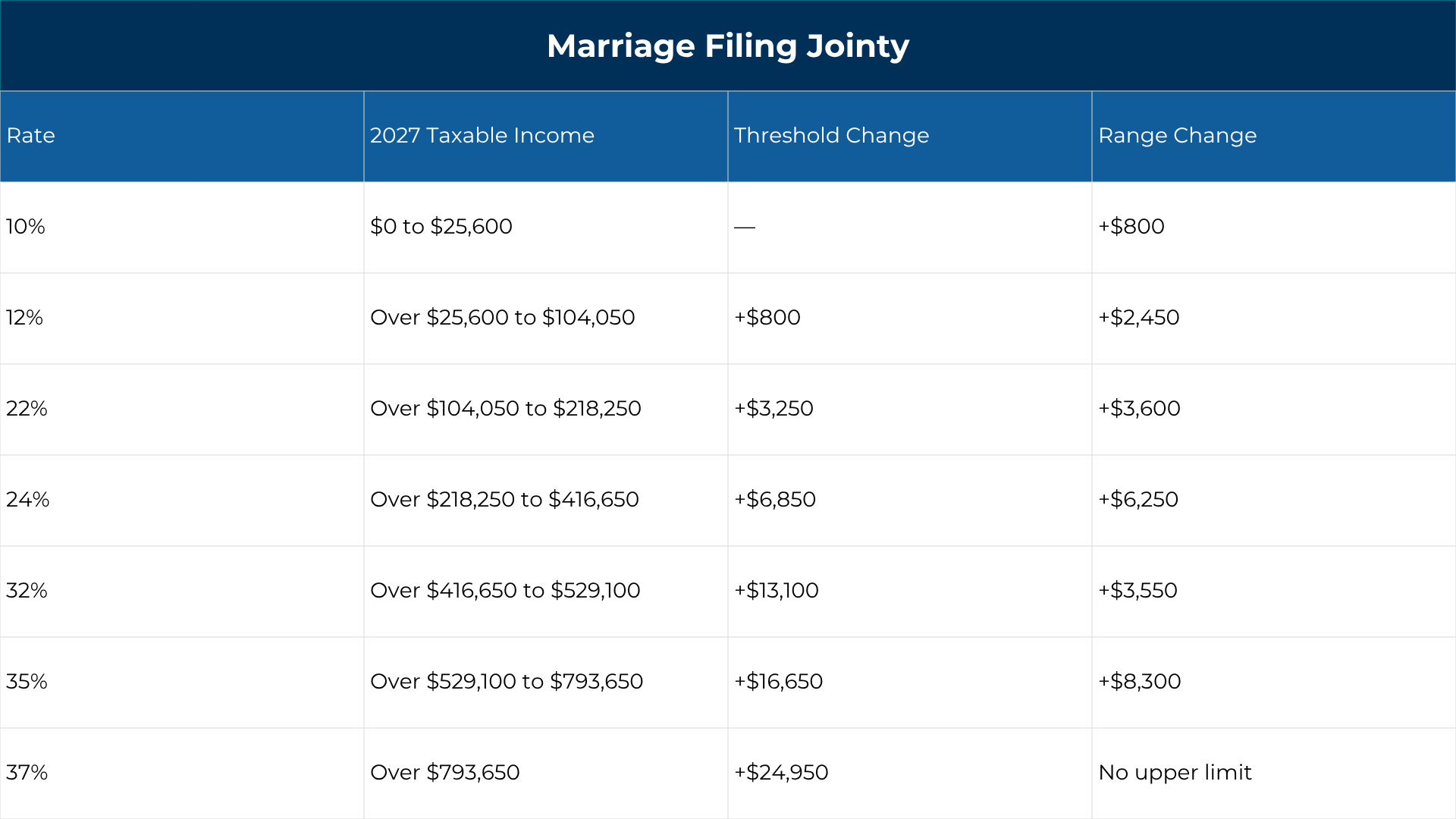
Tax rates are unchanged for 2027, but the income thresholds for each bracket are adjusted for inflation. The tables below show the 2027 taxable income range for each rate, how much higher each bracket now starts (threshold change), and how much more income now falls within each bracket (range change).
Single Filers
Married Filing Jointly
For Families:
Child Tax Credit
The credit available for each qualifying child rises for 2027, along with the portion that can be refunded.
- Maximum credit per qualifying child: $2,200→ $2,300 (+$100)
- Refundable portion: $1,700 →$1,800 (+$100)
Earned Income Tax Credit (EITC)
The maximum EITC for taxpayers withthree or more qualifying children increases. Amounts for other categories arelisted in Revenue Procedure 2026-35.
- Maximum credit, three or more qualifying children: $8,231 → $8,496 (+$265)
Adoption Credit
Both the maximum credit for qualified adoption expenses and its refundable portion increase.
- Maximum qualified adoption expenses: $17,670→ $18,250 (+$580)
- Refundable portion: $5,120 →$5,280 (+$160)
Higher-Income and Estate Planning:
Alternative Minimum Tax (AMT) Exemption
Both the AMT exemption amounts andthe income levels where the exemption begins to phase out are higher for 2027.
Single
- Exemption: $90,100 → $93,000 (+$2,900)
- Phase-out begins: $500,000 → $515,950 (+$15,950)
Married filing jointly
- Exemption: $140,200 → $144,700 (+$4,500)
- Phase-out begins: $1,000,000 → $1,031,900 (+$31,900)
Estate and Gift Tax
The basic exclusion amount applies to estates of decedents who die during the year. The annual gift exclusion is the amount that can be given to any one person during the year without counting toward taxable gifts.
- Basic estate exclusion amount: $15,000,000→ $15,480,000 (+$480,000)
- Annual gift exclusion (per recipient): $19,000→ $20,000 (+$1,000)
For Businesses:
Section 179 Expensing
Businesses can expense more Section 179 property in 2027, and the separate limit for SUVs also rises.
- Maximum Section 179 expense: $2,560,000 → $2,640,000 (+$80,000)
- SUV limit: $32,000 → $33,100 (+$1,100)
Employer-Provided Childcare Tax Credit
The maximum credit for employers that provide childcare increases, with a higher limit for eligible small businesses.
- Maximum credit: $500,000 →$515,943.67 (+$15,943.67)
- Maximum credit for eligible small businesses: $600,000→ $619,132.40 (+$19,132.40)
Employee Benefits:
Qualified Transportation and Parking
The monthly limits for thequalified transportation fringe benefit and qualified parking rise by the sameamount.
- Monthly limit (transportation and parking): $340→ $350 (+$10)
Health Flexible Spending Arrangements (FSAs)
Employees can set aside morethrough salary reductions, and cafeteria plans that allow carryoverscan carry over a larger unused amount.
- Salary reduction contribution limit: $3,400→ $3,500 (+$100)
- Maximum carryover: $680 →$700 (+$20)
Medical Savings Accounts (MSAs)
Deductible ranges and out-of-pocket limits increase for both self-only and family coverage.
Self-only coverage
- Minimum annual deductible: $2,900 → $3,000 (+$100)
- Maximum annual deductible: $4,400 → $4,550 (+$150)
- Maximum out-of-pocket: $5,850 → $6,050 (+$200)
Familycoverage
- Minimum annual deductible: $5,850 → $6,050 (+$200)
- Maximum annual deductible: $8,750 → $9,050 (+$300)
- Maximum out-of-pocket: $10,700 → $11,050 (+$350)
International:
Foreign Earned Income Exclusion
U.S. taxpayers working abroad canexclude more of their foreign earnings in 2027.
- Foreign earned income exclusion: $132,900→ $137,300 (+$4,400)
What Isn’t Changing:
By law, some provisions that wereonce indexed for inflation are not adjusted:
- Personal exemptions: remain at $0.
- Itemized deductions: the overall limitation remains eliminated, although the OBBBA limits the tax benefit of itemized deductions for taxpayers in the 37% bracket.
- Lifetime Learning Credit: the phase-out range stays at $80,000 to $90,000 of modified adjusted gross income ($160,000 to $180,000 for joint returns).
Key Takeaways:
The 2027 adjustments are incremental, but they add up. A higher standard deduction and wider tax brackets mean more income is either shielded from tax or taxed at a lower rate. Families gain from a larger Child Tax Credit and higher EITC and adoption credit limits. Business owners and those planning their estates have higher expensing, estate, and gift limits to work with.
Since these amounts apply to 2027 income and returns filed in 2028, now is a good time to review withholding, health benefit elections, and gifting plans for the coming year. For the full list of adjustments, see IRS Revenue Procedure 2026-35.